
The 2026 Wage Rise and the Compression Problem Nobody Budgeted For
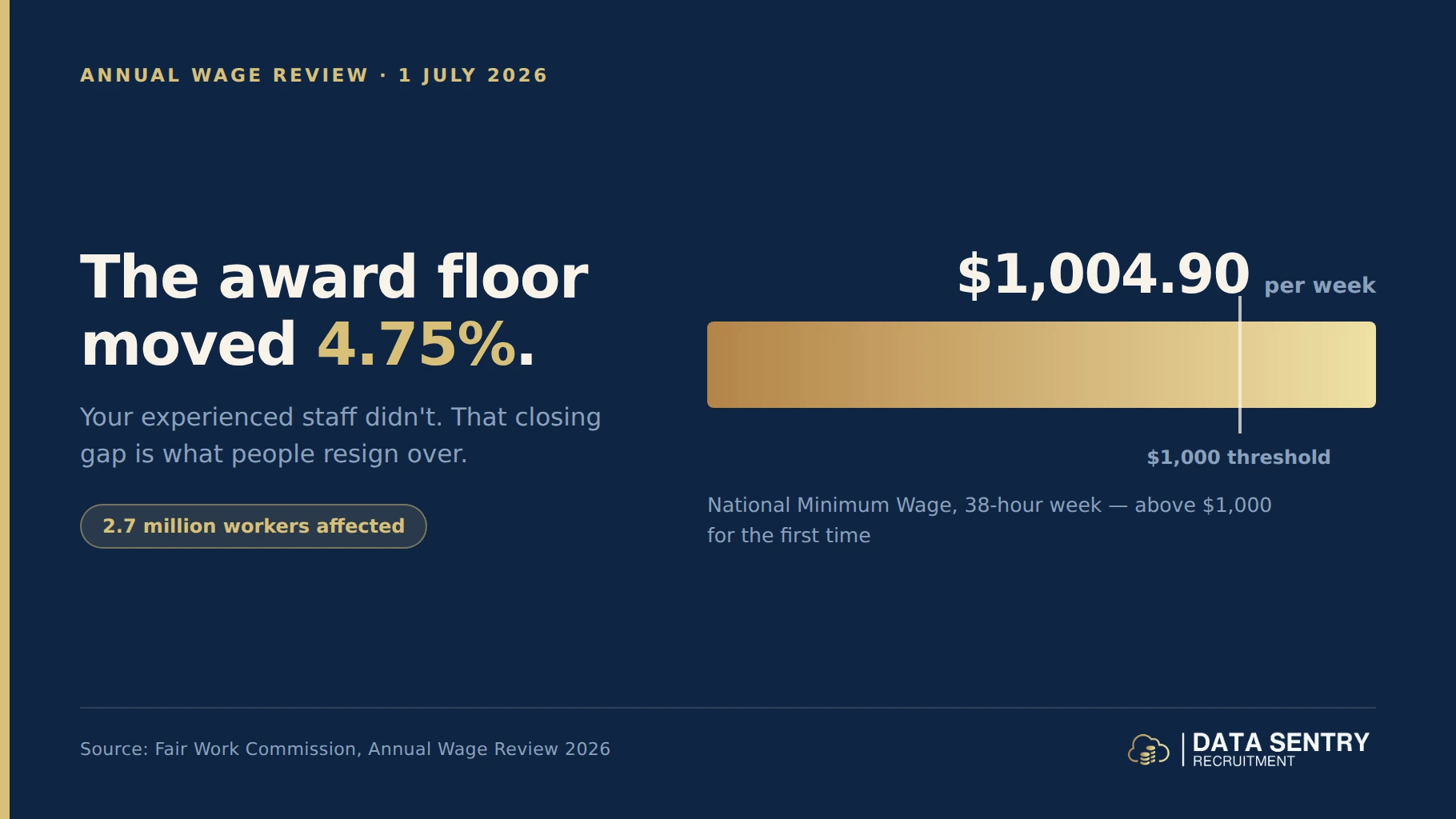
Award floors moved 4.75%. Your experienced staff didn’t. Here’s why that gap is the most common cause of resignations that blindside employers — and how to check yours.
What changed
From 1 July 2026, modern award minimum wages increased by 4.75%. The National Minimum Wage rose to $26.44 an hour — $1,004.90 a week for a 38-hour week, the first time it has cleared $1,000. Around 2.7 million award-reliant and minimum-wage workers are affected.
Most employers budgeted for this. It was announced in advance, it was widely reported, and payroll handled it.
That's not the problem.
The problem is what it did to your pay bands
Award floors moved 4.75%. Market rates for your experienced, above-award staff did not move by the same amount — in most businesses they didn't move at all.
Do that two or three years running and the gap between a brand-new starter and a capable three-year employee quietly closes. This is wage compression, and it is the single most common cause of resignations that blindside employers.
Here's the shape of it. An employer pays a new starter the award floor. They pay a three-year employee a rate they set eighteen months ago, when it felt generous. On 1 July the floor jumps 4.75% and the experienced employee's differential — the thing that made them feel their experience was recognised — shrinks to something they can no longer justify to themselves.
Nobody complains. They just start looking.
Why this shows up as a recruitment problem
By the time compression surfaces, it presents as something else entirely:
- Unexplained resignations from good people who gave no warning and cited "a new opportunity"
- Counter-offers that fail — because the number was never the real issue, the relativity was
- New hires costing more than incumbents in the same role, which spreads the problem the moment it's discovered
- Internal candidates declining promotions where the step up doesn't carry a meaningful step in pay
Every one of those is expensive. Replacing a capable employee costs a multiple of the increase that would have kept them.
What to actually do about it
1. Map your bands against the new floors — not last year's. For each role, write down the current award minimum and what you actually pay at 0, 2 and 5 years of experience. If the spread between a new starter and a five-year employee is under about 15%, you have a live retention risk.
2. Check your bands against the market, not just the award. The award is a floor, not a benchmark. What the market pays for three years' experience in your industry and region is a different number, and it's the one your staff are being shown by recruiters.
3. Fix the relativity, not just the rate. A small, well-explained adjustment that restores the differential does more for retention than a larger one delivered without explanation. People are comparing themselves to the person next to them, not to the CPI.
4. Decide your position before your next hire, not after. The most damaging version of this is discovering the problem because you had to pay a new starter more than someone who has been doing the job for three years.
The uncomfortable one
If you can't afford to restore the differential, that is worth knowing now rather than in six months. It usually means the role is priced below what the market currently pays, and the honest options are to change the role, change the price, or plan for turnover. All three are manageable. Being surprised by it is not.
Related reading
Not sure where your pay bands sit?
We benchmark roles across Australian industries every week. If you'd like a straight answer on what your key roles are actually worth — and where your compression risk is — we're happy to have that conversation.
This article is general information about labour market conditions, not financial, legal or industrial relations advice. For advice on your specific obligations under an award or agreement, speak to your employment lawyer or industrial relations adviser, or contact the Fair Work Ombudsman.