
The 2027 CGT Change Just Put a Clock on Your Succession Hire
The CGT reforms start 1 July 2027 and they’re prospective. That’s pulling succession planning forward — and owner dependency, the thing that discounts a business at sale, takes 12–18 months of hiring to fix.
First, the part that isn't our lane
The 2026–27 Budget legislated significant changes to capital gains tax, commencing 1 July 2027:
- The flat 50% CGT discount for individuals and trusts is replaced by cost base indexation plus a 30% minimum tax on real gains
- The turnover threshold for the small business 50% active asset reduction expands from $2 million to $10 million — meaning effectively all of Australia's 2.7 million active small businesses become eligible
- Assets acquired before 20 September 1985 are deemed sold and reacquired at market value on 1 July 2027
- The changes are prospective: gains accumulated before 1 July 2027 retain the current treatment
Whether that leaves you better or worse off depends entirely on your structure, your asset base, your holding period and your marginal rate. That is a conversation for your accountant, and we'd encourage you to have it early rather than late. We're not going to model it for you, and you should be sceptical of any recruiter who offers to.
The part that is our lane
Here's what we're seeing, and it's the reason this matters to a recruitment audience.
Prospective changes with a firm start date create a planning window, and business owners respond to planning windows by bringing forward decisions they'd been deferring. Succession and exit planning conversations that were vaguely scheduled for "in a few years" are being pulled into the next twelve to eighteen months.
And the single most common thing that destroys value in a small business sale has nothing to do with tax structuring. It's owner dependency.
Buyers discount businesses that can't run without you
A buyer assessing your business is asking one question above all others: what happens to this if the owner leaves?
If the answer is "the key relationships leave with them," "nobody else can price a job," "the technical knowledge is in one head" or "the owner still approves everything," the valuation gets discounted — or the deal gets structured with a long earn-out that keeps you working in a business you no longer own.
Fixing that is not a tax problem or a legal problem. It's a hiring problem, and it is the slowest one on the list.
Why it can't be done quickly
The hire that makes a business saleable — a general manager, an operations lead, a second person who can do the thing only you can currently do — takes time in a way the other pre-sale work doesn't.
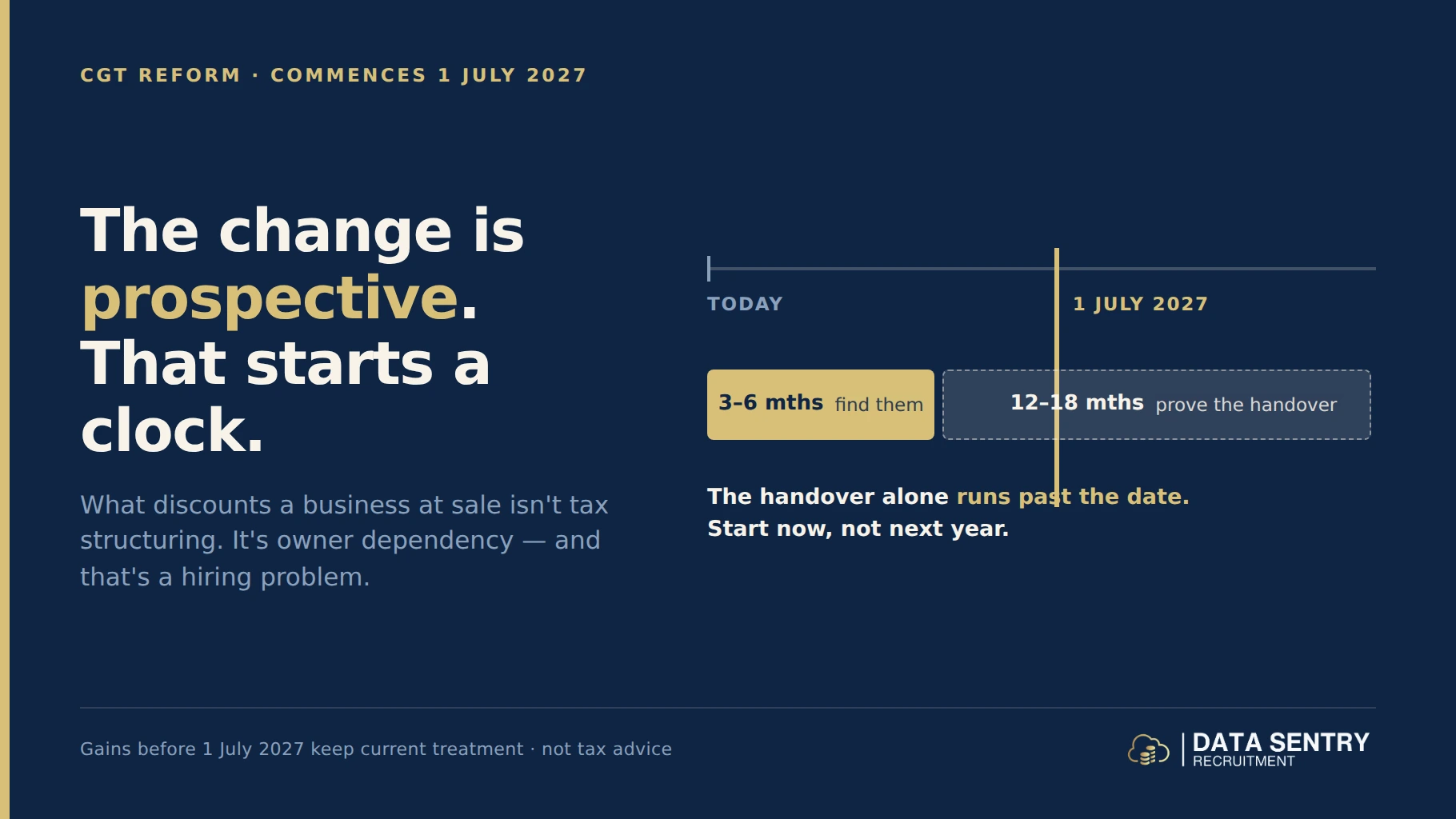
Realistically: three to six months to find the right person, then twelve to eighteen months for them to build the relationships, absorb the knowledge and demonstrate to a buyer that the transfer actually happened. A GM who started six weeks before the sale process proves nothing.
Work backwards from a 30 June 2027 decision point and the recruitment needs to start now, not next year.
What to do about it
1. Have the tax conversation with your accountant this quarter. They can give you the advice we can't, and their answer determines your timeline — which determines your hiring plan. If the answer is "no change to your plans," you've lost an hour. If it's "you should think about your timing," you need the remaining months.
2. Write down what only you can do. Every task, relationship and decision that has no backup. That list is your succession job description, and most owners have never written it down.
3. Identify the single biggest dependency and hire for it first. Not a full restructure. One role, the one that most changes the answer to "what happens if the owner leaves."
4. Give the handover long enough to be visible. A buyer needs to see that the transfer has happened, not that it's planned. That's a twelve-month proof, minimum.
5. Document as you go. Processes, pricing logic, key contacts. This is worth real money at diligence, and it costs nothing but discipline.
If you're not selling
Every one of these steps is also what makes a business survivable if you're sick, want a genuine holiday, or want to stop being the bottleneck on your own growth. The tax change is a prompt, not the reason.
Related reading
Thinking about who could run this without you?
The hire that makes a business saleable takes 12–18 months to prove. If that's on your mind, it's worth a conversation now rather than next year.
This article contains general information about announced tax reforms and is not tax, financial or legal advice. Data Sentry Recruitment is a recruitment firm and does not provide taxation advice. The application of these changes depends entirely on your individual circumstances — speak to your accountant or registered tax agent, and see Treasury and ATO guidance for the detail.